



If you order a premium taxi in Moscow or St. Petersburg, you’re likely to find yourself in a Chinese car. Even if it’s a “Moskvich” (which means “Muscovite”), the only Russian component is the name. In reality, Moskvichs are Sehol X4s made by China’s JAC Motors.
The dominance of Chinese cars in Russia has become a symbol of how life has changed since the full-scale invasion of Ukraine in 2022.
To mark President Vladimir Putin’s visit to Beijing this week, we are looking at the ongoing ‘China-fication’ of the Russian economy. Has China really replaced Europe as Russia’s main trading partner? Is the Kremlin losing revenue as it pivots eastward? What exactly do Russia and China trade?
We also look briefly at a massive Ukrainian drone attack on Moscow; the Kremlin’s decision to replace the popular governor of the “frontline” Belgorod Region, and an exceptionally gloomy official economic forecast.
⏳ This newsletter contains 1,882 words and will take about 10 minutes to read. It was translated and edited by Howard Amos.
The China-fication of Russia’s economy
Russian President Vladimir Putin’s visit to Beijing this week—his first foreign trip in 2026—did not generate much real news. The Kremlin published Wednesday two lengthy joint declarations that were light on substance: one about deepening ties; the other about the emergence of a multipolar world. There was also an announcement that Putin would visit China in November for an Asia-Pacific Economic Cooperation forum.
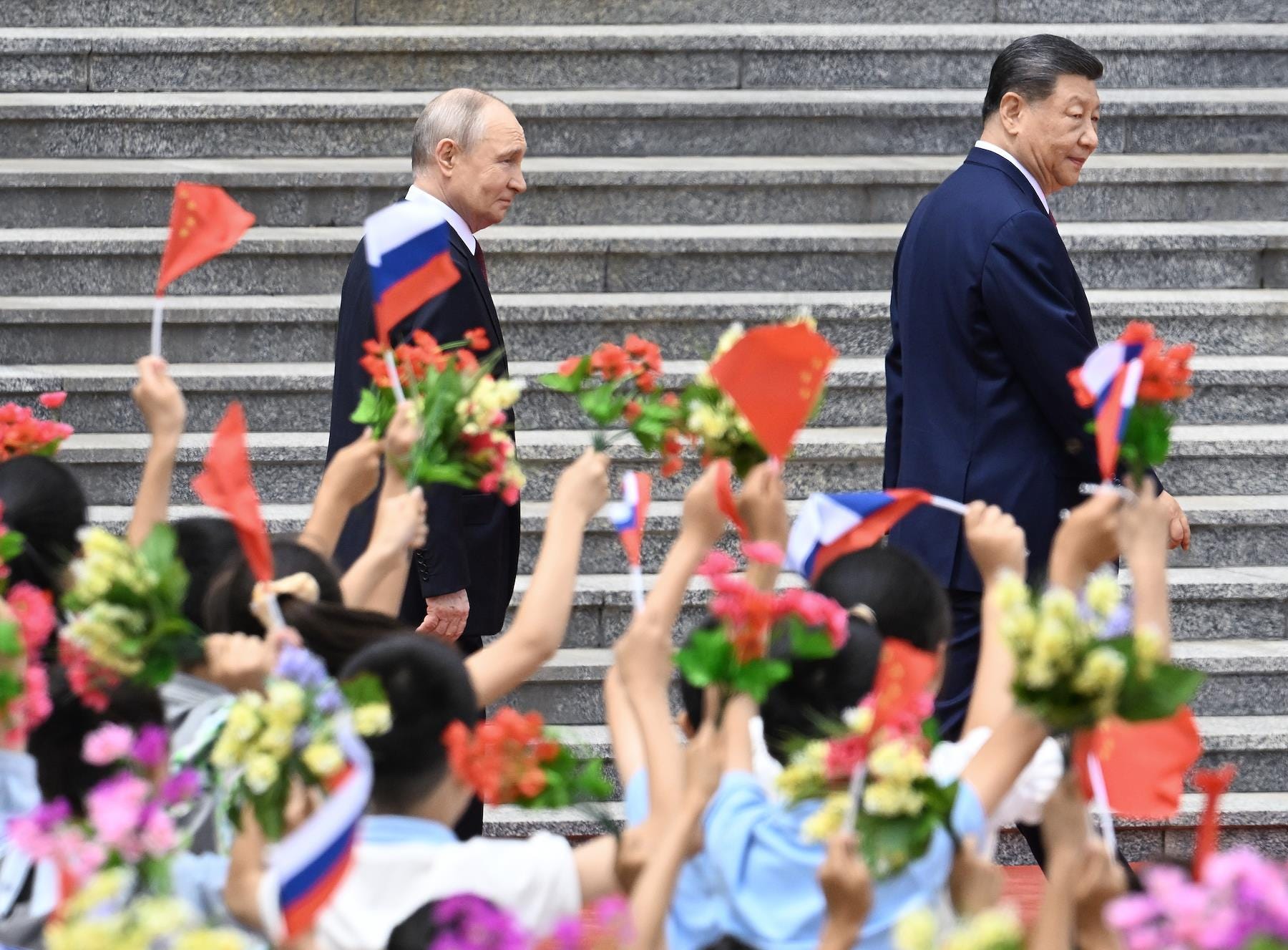
During his visit, Putin heaped compliments on Chinese leader Xi Jinping, and stressed that Russia-China relations were critical for global stability. None of this was surprising: the Russian leader has a genuine reason to be grateful to China. Amid the war in Ukraine and the subsequent tightening of Western sanctions, it was China that stepped in to help. The value of trade between the two countries last year hit a record high of $228 billion (double what it was in 2019), according to Chinese customs data.
In effect, China has replaced the EU, which accounted for 40 percent of Russia’s foreign trade before the war. This becomes clearer when you look at the structure of Russian trade. Although total volumes have not changed much since 2021, the value of trade with EU countries has fallen by over $220 billion; while trade with China has grown by $117 billion. The remaining $100 billion or so has been distributed among other countries, including India and ex-Soviet states that serve as hubs for the re-export of Western goods into Russia.
What does Russia sell to China? Russia exports slightly more to China than it imports. That was true before the war, and remains true today. Since 2019, Russian exports have doubled: from $61 billion to $124.1 billion. Russia supplies China with metals products, timber, fish and seafood, fertilizers, but roughly half the total value of exports is oil and gas.
Although Europe was traditionally Russia’s main market for energy exports, the EU decision to reduce purchases after the full-scale invasion of Ukraine meant the Kremlin increased raw material exports to Asia, primarily China and India (partly by using its “shadow fleet”). Since 2022, the value of Russian energy exports to China has risen over 40 percent. At the end of last year, Russia was China’s largest supplier of both natural gas (24 percent of the market) and oil (17 percent). China is currently the largest buyer of Russian gas and oil.
However, this pivot to the East has not come cheap. Unlike Europe, China purchases raw materials at a discount to global prices. According to calculations by Moscow’s Gaidar Institute, China’s discount on Russian oil was 15 percent in 2022. This subsequently declined, but again rose above 10 percent last year following new U.S. energy sanctions.