


Hello and welcome to your essential guide to Russian politics and economics—written by Farida Rustamova and co-edited by Margarita Liutova. In this brief special edition, we do a deep-dive on the political issue of the day: Russia-U.S. negotiations over the war in Ukraine. Is Russian President Vladimir Putin serious about coming to an agreement with Washington and Kyiv to stop the bloodshed? Or is he just pretending to negotiate?
⏳ This newsletter contains 1492 words – it will take about 8 minutes to read.
We are always delighted if you want to share our reporting! If someone has forwarded this email, you can subscribe here.
Until the moment Putin’s plane touched down last week in Anchorage, Alaska, for face-to-face talks with U.S. President Donald Trump, it was difficult to imagine that a paranoid, security-obsessed president of a warring country would actually visit a U.S. military base. That Putin decided to take this—for him risky— step says a lot about his relationship with Trump and his desire for the U.S. to treat him as an equal.
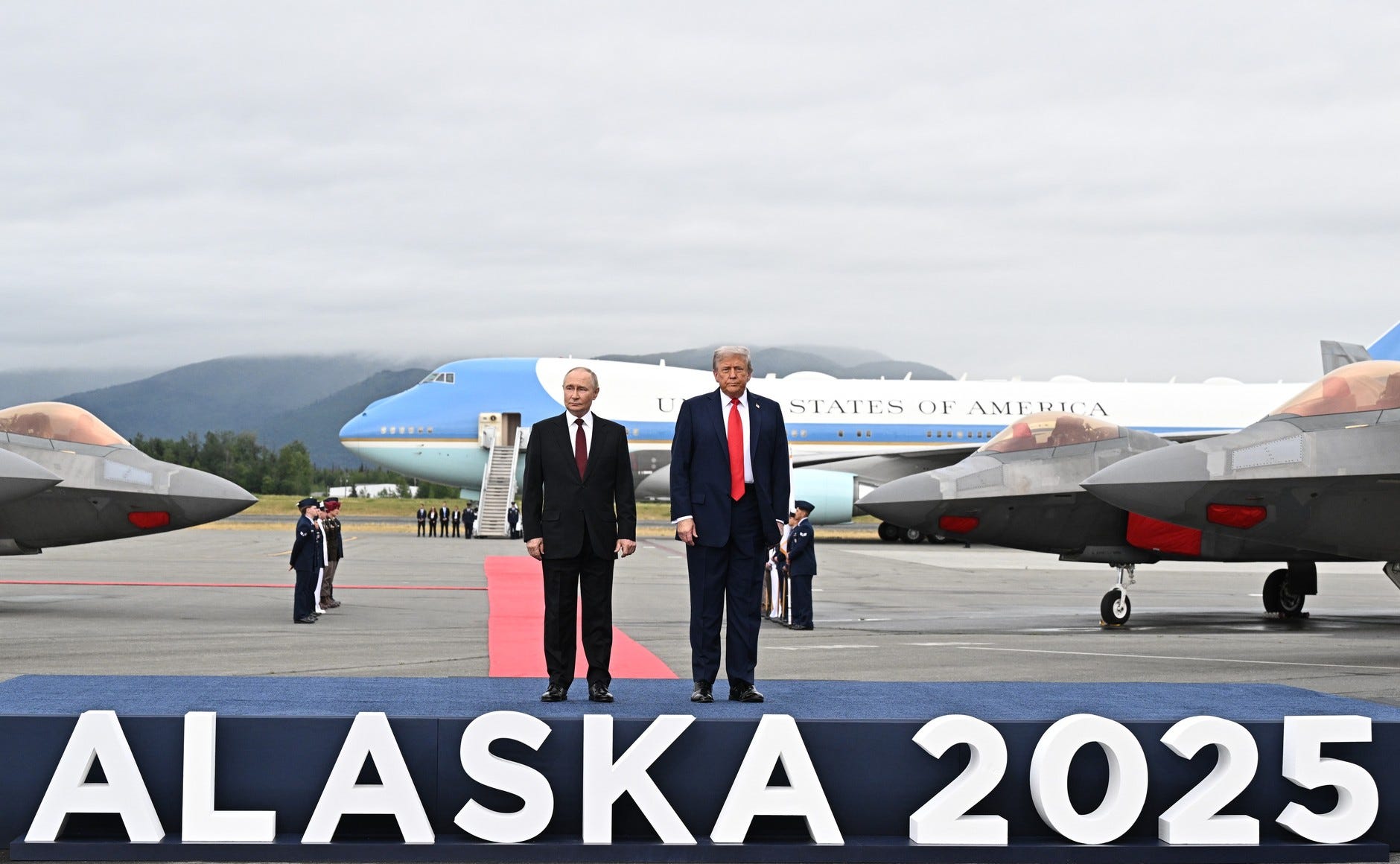
Ahead of the Alaska meeting, Putin had shown a rare willingness to discuss concessions in Ukraine. U.S. envoy Steve Witkoff traveled to Moscow beforehand to convey a U.S. suggestion for Russia to outline points of possible compromise without engaging lengthy historical digressions, according to a source in Moscow familiar with the negotiations. The U.S. also said it would abandon its previous demand that Moscow must agree to a 30-day ceasefire before a president-level meeting could take place. Putin accepted the U.S. proposal, thus paving the way for the Alaska talks.
The Russian side clarified its core demands during Witkoff’s visit, according to the source familiar with the negotiations, telling the U.S. side that its priority was Ukraine not joining NATO, rather than formalizing a land grab. Subsequent comments from U.S. Secretary of State Marco Rubio suggested the Kremlin had succeeded in communicating its position. “I think for the first time, perhaps since this administration began, we have some concrete examples of the kinds of things that Russia would ask for in order to end the war,” he said.
At the Alaska meeting, Putin—again, for the first time—presented a set of demands that, if met, could lead to an end to the conflict, according to our source. However, neither the Russian, nor the U.S. side, has disclosed the specifics.
The secrecy surrounding the talks may be a sign that the Kremlin is seriously contemplating concessions. Much as the decision to launch the full-scale invasion was taken amid the greatest secrecy in Moscow; so might a decision to end the war. It’s possible that one of the conditions under which Putin agreed to the Alaska meeting was that the details of the discussion were not made public. If true, this would explain why, at the press conference in Anchorage, neither Putin nor Trump took questions from journalists. Nor did they reveal any substantive details about their conversation.
“Putin – like Zelensky – cannot publicly discuss territorial compromises in advance. While soldiers are fighting, they cannot openly trade land, or the military will stop fighting,” said the Russian source close to the negotiations.
Some unusual behavior from Putin before and after the Alaska summit may also indicate preparations for a peace agreement. In particular, Putin made 12 calls to world leaders in the days before meeting Trump, and 10 more afterward. Those on Putin’s list included the leaders of post-Soviet states, as well as the presidents of South Africa, India, and Brazil. Official information about the calls was limited, but the Kremlin did say that they were about the negotiations with Trump. There has not been such intensive Russian telephone diplomacy since the full-scale invasion of Ukraine.
In another interesting political move, Putin held special meetings before and after the summit. Both gatherings took place in the Kremlin’s ornate Catherine Hall, which inevitably prompted associations with the famous Security Council meeting just prior to the war, held in the same room and broadcast on live TV, in which Putin interrogated his subordinates about what Russia should do in Ukraine.
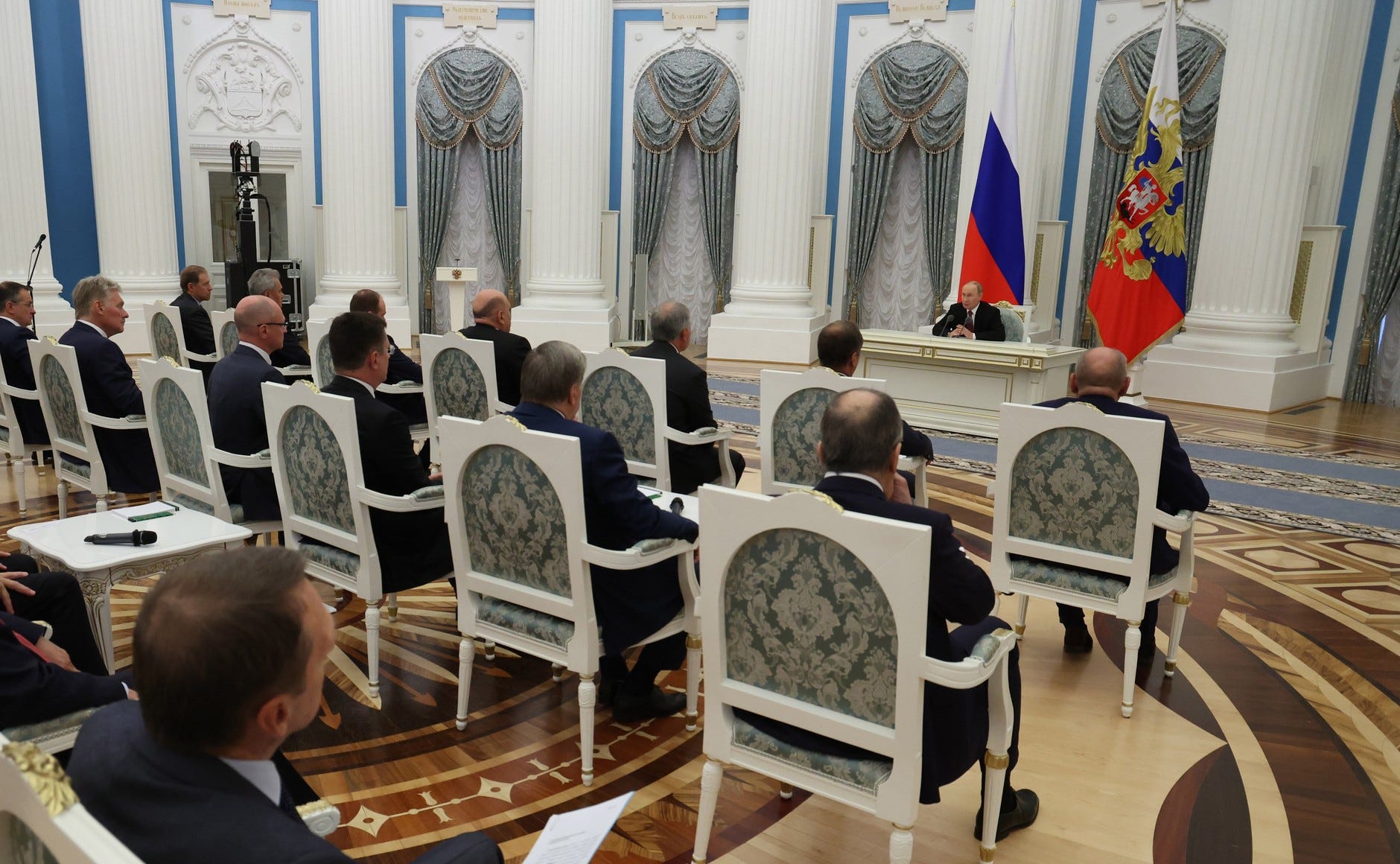
It’s possible that the two recent meetings were—just as in 2022—about Putin seeking to establish collective responsibility ahead of a major decision—in this case, concessions as part of a peace deal. Sources with experience of the Russian political system said it was a fair assumption that the goal of the meetings was to spread the responsibility for a potentially difficult decision.
Amid Russia’s ongoing offensive in eastern Ukraine, Putin has now gained enough in Ukraine that he could package it as a victory for a domestic audience, according to our sources. This is partly because the U.S. has been so explicit about its rejection of NATO membership for Ukraine. “The president already has everything he needs to declare victory if he wants to,” said a source who regularly communicates with Putin.
There would be minimal anger in Russia if Putin decided to go for a deal like the one apparently on the table, said the source close to the negotiations. “He’ll say: I returned historic Russian land, and we also agreed on NATO’s non-expansion, which was the original reason for the dispute. Yes, ‘part of our historic territory remains with the Ukrainian Nazis, but we will resolve this diplomatically’—who in the country would oppose that, except for the approximately 0.5 percent of the population who are [pro-war] lunatics?”
Nevertheless, while there are signs Putin might be edging toward a deal, not enough is known about the recent negotiation to be sure. Above all, there is little public information about the nature of the concessions to which Putin might agree.
After the Alaska talks, Witkoff said that Russia had agreed to security guarantees for Ukraine like NATO’s Article 5. But the Kremlin has never been opposed to such a solution: such guarantees were outlined in a draft peace treaty negotiated in 2022. Similarly, media reports suggested that one of Putin’s demands at the meeting was that the Ukrainian army fully withdraw from Donetsk and Luhansk regions. Our source with knowledge of the talks confirmed this. However, Putin first made this demand a year ago, before a summit of Ukraine’s allies in Switzerland. And the same demand was part of a peace memorandum handed to the Ukrainians by a Russian delegation in Istanbul in June.
All this means—as far as we are aware—that the only change to the Kremlin’s negotiating position in recent weeks has been a willingness to freeze the conflict along the current frontlines in Ukraine’s Kherson and Zaporizhzhia regions. This is a climbdown from Russia’s June memorandum that sought for Ukraine to withdraw all its troops from these two regions (in addition to Donetsk and Luhansk), and officially recognize them as part of Russia.
But this cannot be called a significant concession. First, we do not know whether or not Russia’s readiness to “halt its offensive” means it is abandoning its claims to the entirety of Kherson and Zaporizhzhia regions. Second, in both Kherson and Zaporizhzhia, the front line has been static for almost 3 years, and there is little sign that the Kremlin has the manpower or resources to seize any more territory here in the immediate future.
According to Trump, the next step in peace negotiations should be a bilateral between Putin and Ukrainian President Volodymyr Zelensky. However, it has become increasingly clear this week that Putin will not agree to a bilateral meeting with Zelensky—at least not without a long list of preconditions. The source with knowledge of the negotiations said that Putin would only meet with Zelensky after another round of meetings between Russian and Ukrainian delegations. If, against the odds, a face-to-face were to happen, it would be a major change-of-course from Putin, and likely a sign that a peace deal was close.
Although the Alaska summit gave new momentum to the U.S.-Russia-Ukraine negotiations, an end to the fighting in Ukraine seems as far away as ever. That doesn’t mean the Kremlin will be disappointed. If the outcome of the summit turns out to be that the U.S. stops putting pressure on Russia, no longer seeks an immediate ceasefire, and refrains from imposing new sanctions, it will have been a win for Putin.
Thanks for reading! We always welcome comments, questions, and feedback. If you would like to get in touch, message us at faridaily@proton.me.
Finally, if you know someone else who might also enjoy this newsletter, please spread the word!
Thanks as usual.
One possibility is that Putin has information suggesting that the current offensive in Donetsk can't be sustained, and that Russian troops will soon be forced to retreat. If that happens, he will be under a lot of pressure to agree a ceasefire on worse terms than he could get now. But for the moment, he can cash in on the perception that he is winning to demand that Ukraine withdraw from land it currently holds.
I was listening to Mike Benz’ talk on the 2003 arrest of Mikhail Khodorkovsky, the head of Yukos which was Russia’s largest oil company.
It seems that Khordorkovsky was in the process of merging Yukos with Exxonmobil, Chevron and other western oil companies. This would have essentially put large amounts of Russia’s oil resources under western control.
Khordorkovsky was supposedly being groomed by the CIA as part of a coup against Putin.
That seems to have been the idea of Mike Benz’ talk.
He said something interesting. That was that we engineered the Nordstream pipeline destruction (Nordstream One and partially of Nordstream Two?) because our energy companies could not compete with Russian gas on the basis of price in Europe.
I am persuaded to believe this since it is consistent with what I see being done in Washington and elsewhere. It also seems to be consistent with what I’ve heard about the Victoria Nuland 2014 Maidan coup.
Global corporations and investors certainly must desire to get control of the vast resources of Russia as well as the ample resources of Ukraine.
I may be wrong but we will see.
Will Ukraine be a locus of mass immigration from the Middle East and from Africa after the war?