


Hello and welcome to your essential guide to Russian politics and economics—written by Farida Rustamova and Margarita Liutova. This time, we start with a look at:
How a sluggish economy has forced the Russian government to raise taxes;
What lies behind the resignation of Putin confidante Dmitry Kozak? Why was it unusual? And what will his departure mean?
Laws to tackle telephone fraud look set to make it harder to gauge what Russians think about the war in Ukraine, and the regime.
We also explain how Charlie Kirk became a hero for Russian ultra-conservatives, and a spike in repressive legislation.
⏳ This newsletter contains 1997 words – it will take about 10 minutes to read.
Tax hike
The Ministry of Finance announced tax hikes Wednesday, stating they are needed to “fund defense and security.”
Russia has raised taxes more than once since the start of the war, but this is the first time officials have said explicitly that the money is for the military. The framing is likely a preemptive attempt to head-off criticism.
The main change is a two percentage point increase in VAT to 22%, which will start next year. VAT exemptions for small and medium-sized businesses have also been scrapped. According to the Ministry of Finance, this will provide an extra 1.4 trillion rubles ($16.8 billion) in 2026. VAT accounts for over 40 percent of the revenues in Russia’s federal budget.
It’s noteworthy that the total amount of non-oil and gas revenues projected for 2026 remains exactly the same as the Ministry of Finance predicted last fall. At that time, the Ministry of Finance had not yet planned the VAT rises announced this week—instead, it was basing projected revenue on more optimistic economic growth forecasts (see table). In other words, the VAT hike will compensate for the anticipated fall in VAT and corporate tax revenue caused by Russia’s sluggish economic growth, which is expected to continue into next year.
Next week, we will be sending out a special newsletter analyzing the budget that is due to be sent to the State Duma on Wednesday. If you’re not yet subscribed to Faridaily, please do so now!
Kozak out
The veteran bureaucrat, who opposed the Ukraine war, quit because he no longer had a meaningful role. His departure leaves Putin even more surrounded by yes-men.
The resignation last week of influential Kremlin deputy chief of staff Dmitry Kozak—one of President Vladimir Putin’s oldest colleagues—was a dramatic demonstration of how even Putin’s friends can’t sway his determination to continue fighting in Ukraine.
In recent years, Kozak, 66, had acquired a reputation as one of the few people close to Putin who was opposed to the full-scale invasion. But his skillset had become increasingly irrelevant as the conflict dragged on. This sort of voluntary exit by a political heavyweight is extremely rare in a system that generally frowns upon stepping down. It’s true that Kremlin éminence grise Vladislav Surkov resigned in 2020 without moving to a new political job, but Kozak is even closer to Putin.
Kozak has worked side by side with Putin since the two men were both employed in St. Petersburg government in the early 1990s. He is considered part of the Russian elite’s so-called “St. Petersburg lawyers” group, which also includes ex-president Dmitry Medvedev. And Putin has trusted him with a series of important jobs. For example, after the Beslan school terrorist attack in the early 2000s, Putin made Kozak as his envoy in the Caucasus, tasking him with strengthening federal authority. Between 2007 and 2014, Kozak oversaw preparations for the Sochi Winter Olympics.
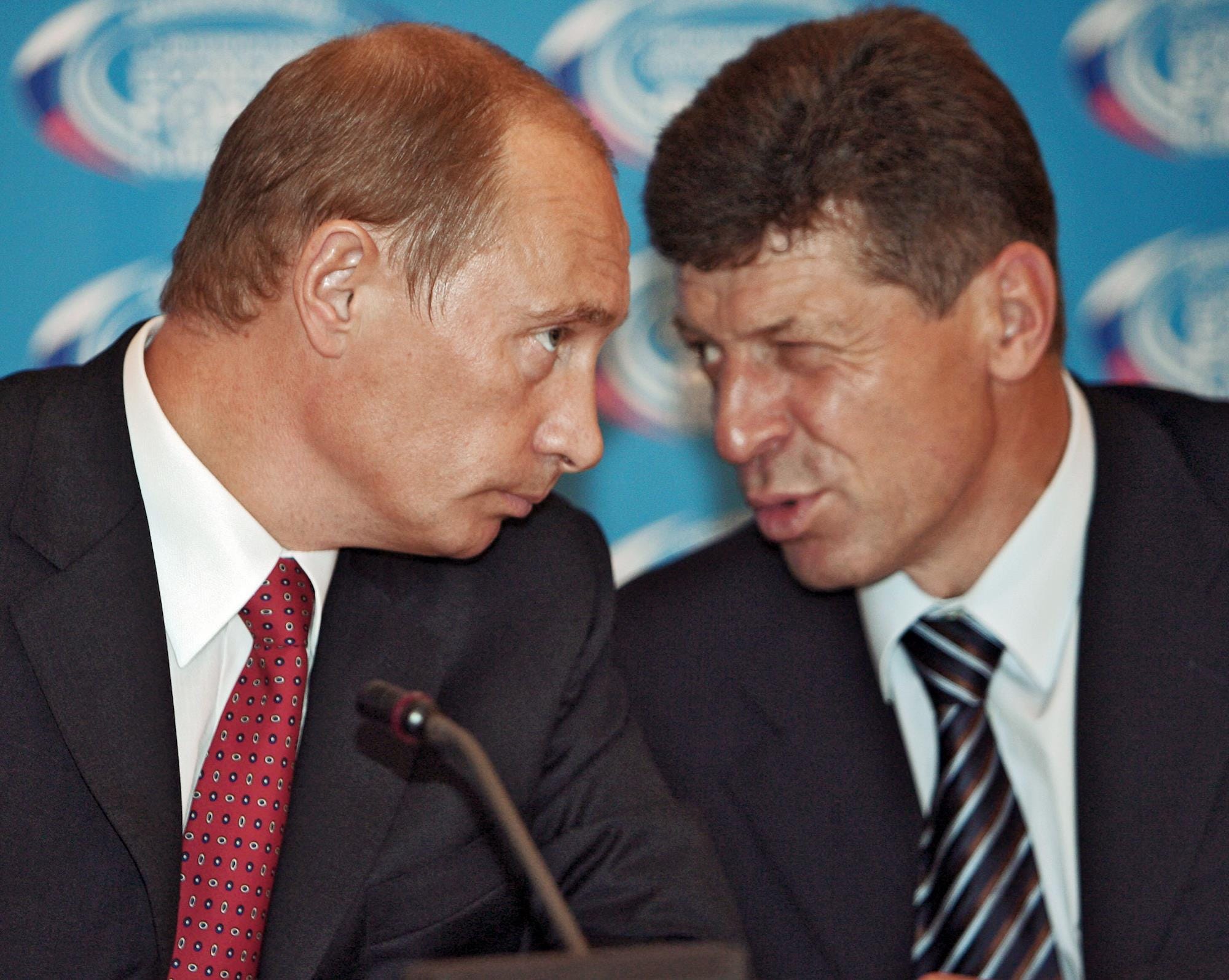
Following Russia’s annexation of Crimea in 2014, Kozak was tasked with overseeing all Ukraine-related matters: Crimea’s development, humanitarian aid to areas of eastern Ukraine controlled by Moscow-backed rebels, and diplomacy. Unofficially, Kozak was also responsible for the socio-economic situation in eastern Ukraine, though this was conducted in secret as Russia publicly denied it was a party to the conflict.
Many media outlets–particularly since his resignation—have cast Kozak as a leading opponent of the war inside the Kremlin. While this is true, it’s also important that he is no bleeding heart liberal; nor are there any doubts about his loyalty to Putin. A Kremlin source said Kozak was “a product of the Russian system.”
Another source was more blunt: “Kozak contributed significantly to what’s happening now,” he said, referring to Kozak’s previous work in Ukraine. “I don’t think something ‘clicked’ for him in 2022.”
Days before Russia’s full-scale invasion got underway in 2022, Putin held a now-infamous, televised meeting of the Security Council at which he demanded all members speak their minds about recognizing the independence of the Moscow-backed Donetsk People's Republic and Luhansk People’s Republic. Kozak was the only one who did not openly support the idea. According to a close acquaintance, Kozak tried to convince Putin that annexing Ukrainian territories was dangerous, and that war should be avoided.
Government sources told us subsequently that Kozak repeatedly tried to persuade Putin to stop the bloodshed in Ukraine, and engage in negotiations. There have been similar reports in Western media, citing sources in the Kremlin. “Most were against it [the invasion], but Dima [Kozak] dared to say it directly [to Putin],” said the close acquaintance of Kozak.
However, the main reason for Kozak’s departure was bureaucratic. “Putin was tired of Kozak, and Kozak was tired of living as an outcast,” said the acquaintance. Amid the war, Kozak’s previous role in Ukraine-related matters had become irrelevant. And he had suffered a series of reversals in his other position of overseeing relations with Moldova, and the Georgian breakaway regions of Abkhazia and South Ossetia. Indeed, earlier this year, the Moldova, Abkhazia and South Ossetia brief was given to another influential Kremlin deputy chief of staff, Sergei Kiriyenko. Unlike Kozak, Kiriyenko has embraced the new political reality that followed the full-scale invasion.
Earlier this year, Kozak had tried to get Putin to appoint him Russia’s negotiator-in-chief for talks about Ukraine with the incoming U.S. administration of President Donald Trump, according to his acquaintance. But Putin was not amenable. According to our sources, when, later, Putin discovered Kozak wanted to resign, he offered him the role of presidential envoy to northwestern Russia (Putin prefers to avoid firing influential officials to prevent resentment or conspiracies). But Kozak turned him down. They did, however, part amicably: their last meeting was described as “cordial” by another acquaintance of Kozak.
Reportedly, Kozak—who has spent his whole life working for the state—is now seeking a job in business. If he does end up in the private sector, parallels will undoubtedly be drawn with another of Putin’s old colleagues from St. Petersburg—Alexei Kudrin—who was known to be close to Putin, and worked as Finance Minister and head of the Audit Chamber. After the full-scale invasion, Kudrin got a job at Yandex, Russia’s leading internet company.
Despite never publicly criticizing Putin, or the war, Kozak was still one of the few people in Putin’s inner circle with the stature and courage to voice uncomfortable truths. With his departure, Putin will have even less exposure to dissenting voices.
Analysis in brief
The killing of U.S. conservative activist Charlie Kirk has made him a hero for Russian ultra-conservatives. In recent days, the assassination has been widely discussed by nationalists, state propagandists, and even senior Orthodox clerics. For most, it served as yet another chance to argue “traditional values” are under threat in a “decaying” West.
As well as extensive coverage of Kirk’s funeral this week by state-owned media, prominent figures to mourn the controversial U.S. activist include Kirill Dmitriev, a mediator in Russia-U.S. talks, who posted on X about Kirk’s spiritual contribution to Christianity; Tikhon Shevkunov, an Orthodox bishop dubbed “Putin’s confessor,” who published an article on Kirk’s role in promoting Christianity; and arch conservative tycoon Konstantin Malofeev, who began a recent far-right conference with a minute’s silence for Kirk.
The number of repressive laws passed by the Russian parliament during its spring session was the highest of any session since the full-scale invasion of Ukraine, according to our calculations. Such new laws included those restricting freedom of speech, access to information, and minority rights; those increasing persecution of so-called “foreign agents”; and those toughening the rules around conscription and mobilization, and many others.
Interestingly, the number of repressive laws significantly decreased on either side of the 2024 presidential election campaign—likely because the Kremlin was trying not to stir controversy. Although the general direction of travel when it comes to legislation is clear (more repression), it’s important to emphasize that Russia’s lawmaking processes are influenced by many factors—from Putin’s wishes, to foreign policy and election cycles.
Making polling harder
Polling organizations are sounding the alarm over a government campaign against telephone fraud that could curtail their ability to gauge public opinion.
“We’re getting ready for possibly our last telephone poll,” an employee of an independent pollster studying attitudes toward the war in Russia said last week. As a result of a series of new laws, organizations will be banned from contacting anyone who hasn’t given prior consent (how this will be enforced is unclear). Additionally, mobile phone operators must label calls, displaying categories like “bank,” “police,” or “poll” alongside a number.
These rules look set to create significant problems for those conducting public opinion surveys via telephone in Russia. In particular, the requirement for prior consent is extremely difficult to meet. But an even bigger issue will be a sharp rise in communication costs. Call labeling and other legal requirements will increase outlays for mobile operators, which they will pass on to clients. Operators are set to charge for every call attempt—even if it doesn’t connect (previously, only successful calls were billed). And a special tariff for so-called “mass calling” will be introduced. This will increase the costs of conducting surveys drastically, according to polling companies. Accurate polling requires placing millions of calls.
Even the state-owned VTsIOM polling agency—which is known for delivering surveys that suggest sky-high approval ratings for Putin—has publicly joined the industry discontent. In a statement, VTsIOM said telephone polls were “on the verge of extinction,” and that thousands of workers in the sector could be laid off.
In response to the complaints, the Ministry of Digital Development suggested creating a special list of organizations exempt from the prior-consent rule. Whether inclusion in this list would mean lower tariffs from mobile operators, though, remains unclear. Of course, the government, which will approve the list, could easily exclude independent polling agencies.
Russia’s most prominent independent pollster, Levada Center, will be less affected than most because it mostly uses in-person interviews rather than phone calls. Levada’s polls are sometimes criticized for being unrepresentative as, supposedly, respondents feel less anonymous when interviewed in person—and are thus less likely to express dissent. For instance, Levada polling this year showed that between 13 percent and 16 percent of Russians opposed the war in Ukraine, while phone polls by independent outfits suggested it could be between 19 percent and 34 percent.
Other independent pollsters—like Chronicles and Russian Field—which rely heavily on phone surveys, are in a tougher spot. Russian Field has already said it may switch to in-person interviews—although this will inevitably affect survey speed, and cost. Replacing phone interviews with online surveys is also a poor solution: this reduces sample representativeness (e.g., by underrepresenting older people) and forces pollsters to be even more cautious when it comes to wording (to avoid online censorship).
In targeting telephone fraud, it’s unlikely the authorities were setting out to find a convoluted way to hinder the work of independent pollsters. But the Kremlin has always been irritated by surveys of public opinion that suggest that maybe the vast majority of the country is not behind Putin—and may seize this opportunity. Either way, amid war, censorship, and political repression, it has become notoriously difficult to gauge public opinion. And these measures look set to make it harder still.
Thanks for reading! We always welcome comments, questions, and feedback. If you would like to get in touch, message us at faridaily@proton.me.
Finally, if you know someone else who might also enjoy this newsletter, please spread the word!
You have provided several factually false statements in your post. This is not the first time you do it. Let's correct you.
D. Kozak has always been a yes-man in Russia.
D. Kozak remains the yes man in Russia.
D. Kozak has never opposed the Ukraine war.
D. Kozak has not left Putin, he still performs functions changed from Moldova / Ukraine matters: he will play a "dissident in the Kremlin" which he has never been. So Putin remains surrounded by the same proportion of yes-men.
D. Kozak is now trying to get cleaned for the West and even "emigrate" to the West, where he will be doing all the tasks the Kremlin may assign on him.
You seem to contribute to Kozak's being whitewashed.
P.S. Elvira Nabiulina has never ever been against the Russian war with Ukraine either.
Putin and the war: “Who rides on the back of a tiger can never dismount.”