

Welcome to Vlast! This time we look at the fallout from the gasoline shortages in Russia caused by Ukrainian strikes on oil refineries. When they first began, lines at gas stations and rising prices were an inconvenience—now, they’ve become Russia’s most important domestic political issue. Could public unhappiness even threaten the regime?
We also look briefly at why Moscow Mayor Sergei Sobyanin has been given a major role in September parliamentary elections, the jailing of a soldier who threatened to mutiny in a viral video, and the death of longstanding Putin ally Sergei Ivanov.
⏳ This newsletter contains 1,614 words and will take approximately 8 minutes to read. It was translated and edited by Howard Amos.
While gasoline shortages have not led to organized anti-regime protests, they have meant widespread public anger, a political headache for the Kremlin, and economic problems.
Russian President Vladimir Putin made his first public acknowledgement Sunday of the country’s gasoline crisis, which has caused the price of fuel to spike, rationing at gas stations, and huge lines of cars seeking fuel. The format of his intervention was telling: rather than a special address to the nation (something usually reserved for major events like the announcement of the full-scale invasion of Ukraine in 2022), or discussing the issue at a government meeting, he gave an interview to Pavel Zarubin, the Kremlin’s “court journalist.” For long sections of the exchange, Putin was obviously reading off a teleprompter.
Responding to one of Zarubin’s pre-agreed questions, Putin admitted that Ukrainian strikes were causing gasoline shortages, but he claimed them were “not critical.” Then, he quickly shifted the topic of conversation from to the state of negotiations over the Ukraine war, and a lengthy account of Russia’s military successes.
Even such an understated acknowledgment of a domestic problem is unusual for Putin, who traditionally prefers to distance himself from bad news. For example, during what were Russia’s then biggest-ever gasoline shortages in September last year, he did not once mention the issue in public.
The current problem is so severe, however, that Kremlin managers apparently decided Putin would risk looking too detached from reality if he ignored it (they were likely also swayed by Putin’s declining approval ratings, and upcoming parliamentary elections). Apparently, the Kremlin wanted to show that Putin was fully up-to-speed on recent developments—as well as portraying Kyiv as solely responsible for lines at gas stations and rising prices.
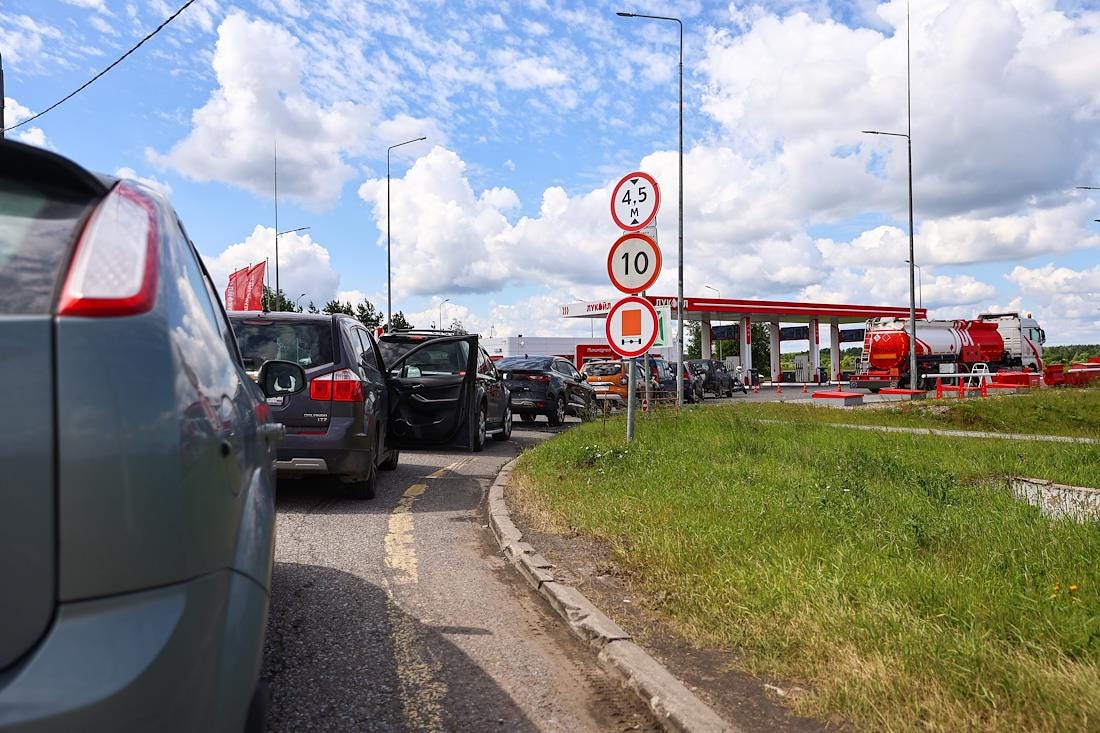
In other words, the Kremlin is hoping for a “rally around the flag” effect. This is possible. Independent surveys in Russia’s border regions in 2023, for example, found that, as Ukrainian attacks intensified, the share of respondents expressing support for the Kremlin increased. And it’s undeniable that Ukraine’s growing strike campaign inside Russia has led to an increase in civilian casualties (although they remain far below those caused by Russia in Ukraine), which could fuel public anger and strengthen support for the war.
On the other hand, most Russians do not feel they are in immediate danger. Instead, what concerns people seems to be the deteriorating economic situation. There is not yet any polling data on the gasoline crisis, but criticism of the government is easy to find on Russian social media. This is often summed up by a simple question: “How can a country with some of the world’s largest oil reserves run out of gasoline?” You can also find anger directed at Ukraine, but this appears to be less common.

At this stage, it seems unlikely that gasoline shortages will lead to anti-war protests. In a crisis, most Russians choose adaptation over confrontation—not only individually, but also through grassroots activism. Moscow residents recently created a crowdsourced online map that shows gas stations where fuel was available, and the lines shorter. The information is continuously updated by users. Similar projects have appeared in other Russian regions.
The authorities have encouraged this process, with officials, lawmakers, and pro-government commentators urging Russians to get used to the new reality. As Federation Council Speaker Valentina Matvienko put it: people should stop “wringing their hands.”
How long will the shortages last?