

Hello and welcome to Vlast! This is a special edition newsletter looking at the record defense spending in Russia’s recently-released 2027 budget.
There is no paywall this time! If you want to support our work, please consider upgrading to paid.
⏳ This newsletter contains 727 words and will take approximately 3 minutes to read. It was translated and edited by Howard Amos.
The Russian government submitted to parliament on Wednesday a 3-year draft budget that included a post-Soviet record for defense spending in 2027. The huge resources being committed suggest that the Kremlin does not expect the war with Ukraine to end any time soon—and may even be preparing to expand the conflict.
“This is an ultra-militarized budget,” an official who worked on the document told Vlast.
Spending on what the government terms “national defense” next year will be significantly higher than expected, according to the draft, amounting to about 17.1 trillion rubles ($196 billion), or 6.9 percent of projected GDP. When spending on “national security” (the police, National Guard, and intelligence agencies) is added, a staggering 44 percent of Russian spending in 2027 (8.8 percent of GDP) will be related to the military and security services. That is an absolute record.
Before the full-scale invasion, Russia’s defense bill was far lower. Between 2011 and 2022, 29 percent of all spending went toward the military and security services (5.3 percent of GDP).
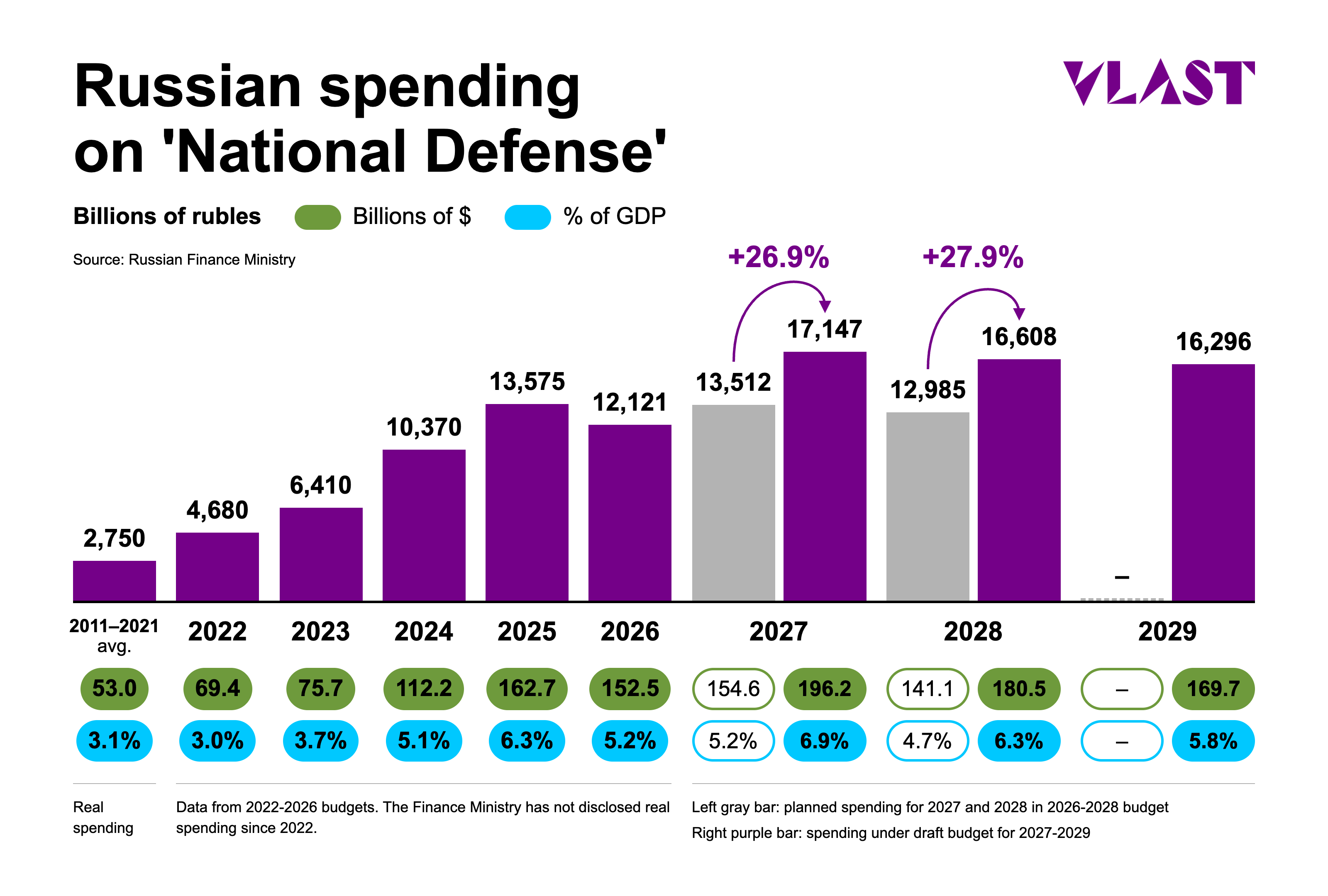
It’s important to remember that real spending in 2027 is likely to be even higher. Over the course of the war in Ukraine, Finance Ministry planners have repeatedly lowballed defense spending. Notably, the budget deficit was almost five times higher than the official target in 2025, and grew 52 percent between January and August this year.
According to the official who took part in drafting the budget, Ukrainian drone strikes on Russian oil refineries and warehouses earlier this year influenced the decision to make such big increases. “This was all happening in the spring and summer, precisely when the budget was being prepared,” he said.
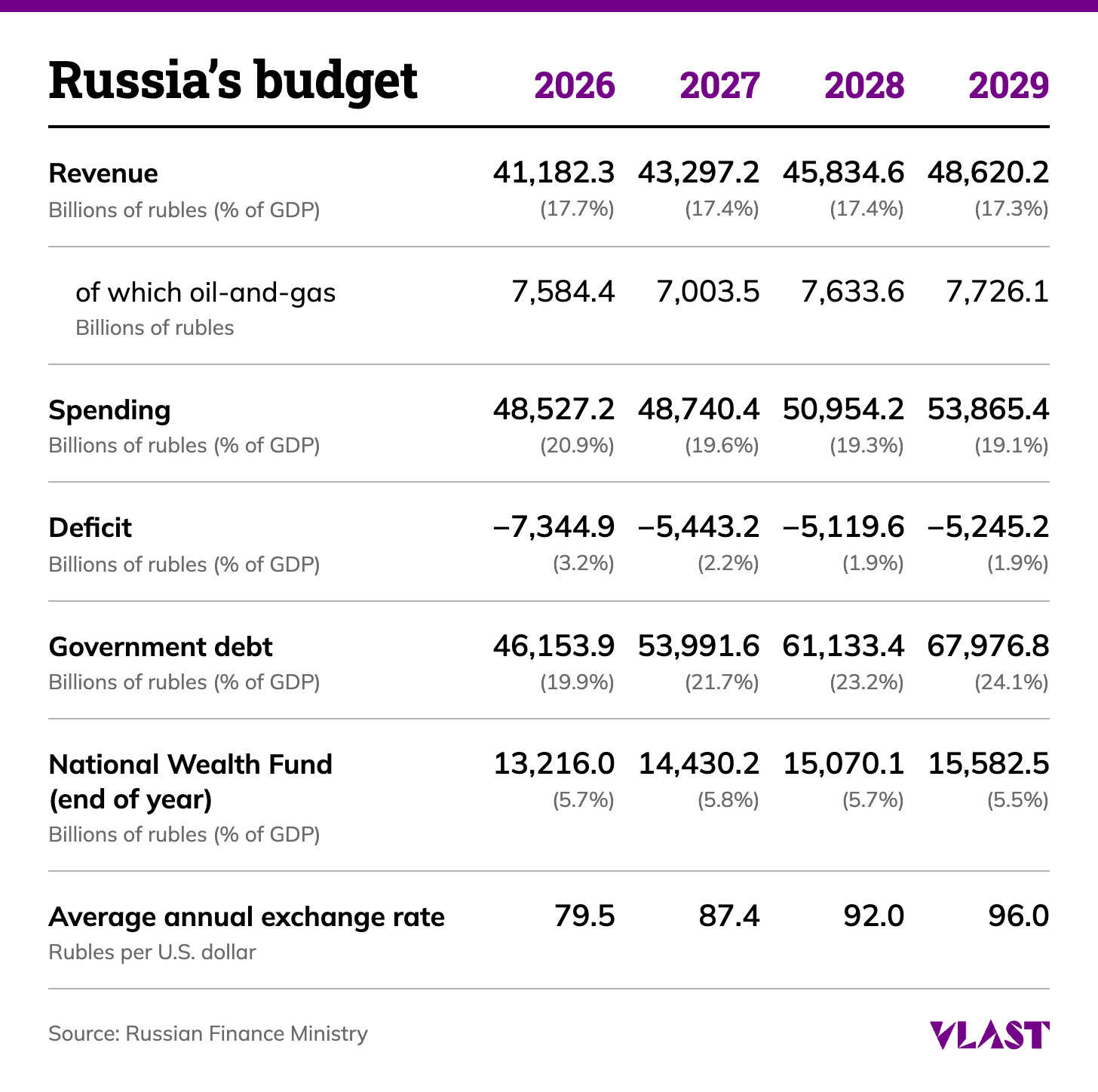
The defense spending plans come despite the Finance Ministry expecting a decline in oil and gas revenues this year and next. According to official estimates, oil and gas revenue will be at historic lows: just 16.2 percent of total revenue in 2026 and 16.6 percent in 2027.
Where will the Kremlin get the money for defense?
First, tax increases are planned for next year (although they will not be as big as recent ones). The Kremlin wants to increase taxes on income earned from securities and bank deposits, as well as tax companies that earn extra income from the sale of gold, some base metals, and fertilizers amid higher global commodity prices. Russian mining and fertilizer companies will pay a 30 percent windfall tax, while gold producers will pay 20 percent.
Second, social spending and investment will fall. This clearly shows that the Kremlin does not have enough money to finance both the war and social and economic development projects—and that it is prioritizing the war. In previous years, the authorities had avoided across-the-board cuts to non-military spending.
Finally, almost the entire budget deficit in 2027 (as well as the unplanned increases to the deficit this year) will be financed via government debt. For the first time in modern Russian history, public debt will exceed 20 percent of GDP (it was about 15 percent before the full-scale invasion of Ukraine in 2022).
The unveiling of Russia’s budget—which now needs to be rubber-stamped by parliament and then signed into law by President Vladimir Putin—has coincided with increasingly aggressive rhetoric from the Kremlin.
“After everything they [Ukraine] have done, we will think twice about what we need to do in response,” Putin said last month in response to a question about resuming negotiations. And, speaking on Thursday, Putin rejected a proposal from Kyiv and Washington for a halt to mutual energy infrastructure strikes, calling it “absurd.” In recent weeks, Russia has attacked energy facilities, data centers, and other infrastructure across Ukraine. Strikes on Kyiv have been an almost daily occurrence, with regular civilian casualties.

This newsletter was compiled with input from a journalist who wished to remain unidentified for security reasons.