



Hello and welcome to your essential guide to Russian politics and economics—written by Farida Rustamova and Margarita Liutova. This time, our main topics are:
Why Russia has reversed years of claiming the U.S. is its number one enemy and now has Europe in its sights;
How ineffective regulation and long-standing problems have made Russia’s oil refineries an easy target for Ukrainian drones, triggering a gasoline crisis.
We also look briefly at a record number of treason cases in the first half of this year, and a series of political attacks on the liberal Yabloko party.
⏳ This newsletter contains 1656 words – it will take about 7 minutes to read.
If you’re still not subscribed to our newsletter, then you can do so here. Subscribing is a great way to show us your support:
Foreign policy volte face
At the same time as Putin’s rhetoric becomes more anti-Europe, so Russian drones are increasingly disrupting European airspace.
Russian President Vladimir Putin delivered a geopolitical rant last week at the Valdai Discussion Club, a forum of Russia experts, which appeared to crystallize a new foreign policy direction. These were Putin’s first public comments on foreign affairs for several weeks, and he made it abundantly clear that Europe—not the United States—is now Russia’s primary adversary. This is a major break with the official public narrative of the last decade, when Washington was always presented as Russia’s number one enemy.
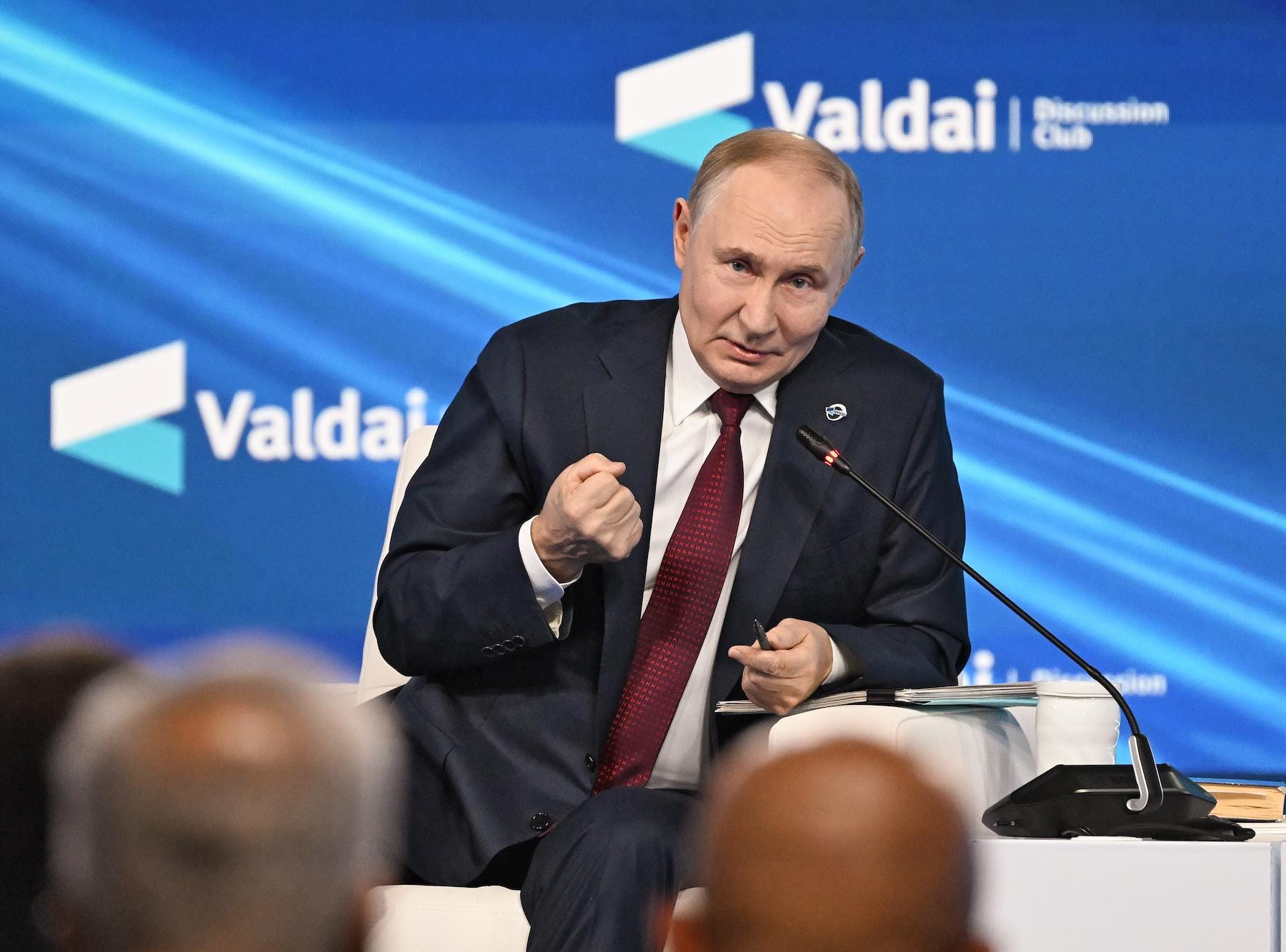
Significantly, the Kremlin’s new position is not just confined to rhetoric. In recent weeks, drones, likely of Russian origin, have regularly entered the airspace of European countries, and cyberattacks—also presumably Russian-directed—have disrupted the operations of European airports. German Chancellor Friedrich Merz said this week that the Kremlin is waging a hybrid war against his country.
At Valdai, Putin argued that European elites were fueling hysteria over the possible outbreak of war with Russia, and that Europe’s hawkish position on the fighting in Ukraine means it’s impossible to find a compromise peace.
“It has proved impossible to stop the fighting,” said Putin. “The responsibility for this lies not with an ‘international majority’ but a minority, mostly in Europe, who are always seeking to escalate the conflict.”
Putin added that, while the Kremlin has no intention of fighting NATO, it was closely monitoring “Europe’s growing militarization” and was prepared to take reciprocal military measures if necessary.
Asked about the drone incidents in European cities, Putin jokingly promised not to do it anymore. But then he went on to claim—seriously—that Europeans are launching drones themselves to “escalate tensions” and increase defense spending.
Of course, Russian officials have criticised Europe in the past, but this criticism was almost always accompanied by the claim that European leaders were entirely dependent on Washington—and were not capable of independent decisions. They were, in other words, puppets. The Kremlin’s designation of the U.S. as the world’s leading anti-Russia force was even formalized in state documents. For example, a 2023 update to Russia’s “foreign policy concept” claimed the “U.S. and its satellites” were waging a hybrid war against Russia.
However, after Donald Trump’s return to the White House, the Kremlin began toning down its anti-U.S. rhetoric, while simultaneously intensifying criticism of Europe. This criticism escalated in August when European leaders, together with Ukrainian President Volodymyr Zelensky, outlined their vision for an end to the war. The Kremlin reacted particularly negatively to Europe’s intention to continue providing military aid to Kyiv in peacetime.
This portrayal of Europe as Russia’s main adversary is also peddled aggressively by Russian propaganda, with state-owned television regularly broadcasting claims that Europe is fueling the war in Ukraine. The belief that Europe is preventing an end to the war in Ukraine is also widespread among Russian officials (even among those who did not support the full-scale invasion in 2022).
“Instead of saving what remains of Ukraine, Europeans are provoking Putin to continue the war,” said a source close to the Russian government. European leaders are “in a religious frenzy” when it comes to anti-Russianness, said another source close to the government, and are unwilling to end the fighting in Ukraine.
Of course, Putin’s newly-discovered anti-Europe messaging echoes the criticism of Europe that has been made by Trump. In other words, Putin is trying to align himself with the U.S. and, at the same time, exacerbate the divisions between Washington and European capitals. However, Putin’s foreign policy rant at Valdai was also an acknowledgement that there is a deadlock when it comes to diplomatic efforts to bring an end to the fighting in Ukraine. There has been no breakthrough—not even behind-the-scenes—following the Trump-Putin summit in Alaska that was held in August.