



Welcome to the first edition of Vlast! This time we look at:
How the FSB’s pursuit of total control over the Russian internet has caused serious disagreements in the elite, risking a political backlash.
Desperate to find more revenue, officials are mulling whether to impose taxes on an innovative and extremely popular instant payment network.
We also examine police raids on the Moscow offices of Novaya Gazeta, and why Putin allowed famous icons from a museum to be transferred to the Orthodox Church.
⏳This newsletter contains 2,164 words and will take about 10 minutes to read. It was translated and edited by Howard Amos.
While the recent rebranding of “Faridaily” as “Vlast” means that, from now on, our newsletters will look and feel different, there will be no change to the quality of our content, or the terms of your subscription. You will continue to receive newsletters twice a month to the same email address.
Putin sides with FSB amid anger over internet restrictions
The blocking of Telegram, a campaign against VPNs, and internet shutdowns have complicated the lives of bureaucrats, and caused business people to lose money.
At a Saturday morning meeting last month, executives from Russia’s largest telecom operators and internet companies were surprised to be handed a document by Digital Minister Maksut Shadayev, who was accompanied by an unidentified officer from the Federal Security Services (FSB). They were told to sign immediately. According to journalist Maria Kolomychenko, the document obliged their companies to stop working with clients who are using Virtual Private Networks (VPN) to evade internet restrictions—a common practice in Russia, where hundreds of major internet platforms and media outlets are blocked.
The executives were outraged by the request, and went to the press. Their willingness to brief journalists attested to the depth of their anger—after all, it has long been taboo for members of the elite to air their dirty laundry in public.
“Everyone is against [more internet restrictions] except one agency,” said a high-ranking source close to the government, referring to the FSB. “My teenage children complain: ‘Come to your senses, what are you doing?’” said another source close to the government.
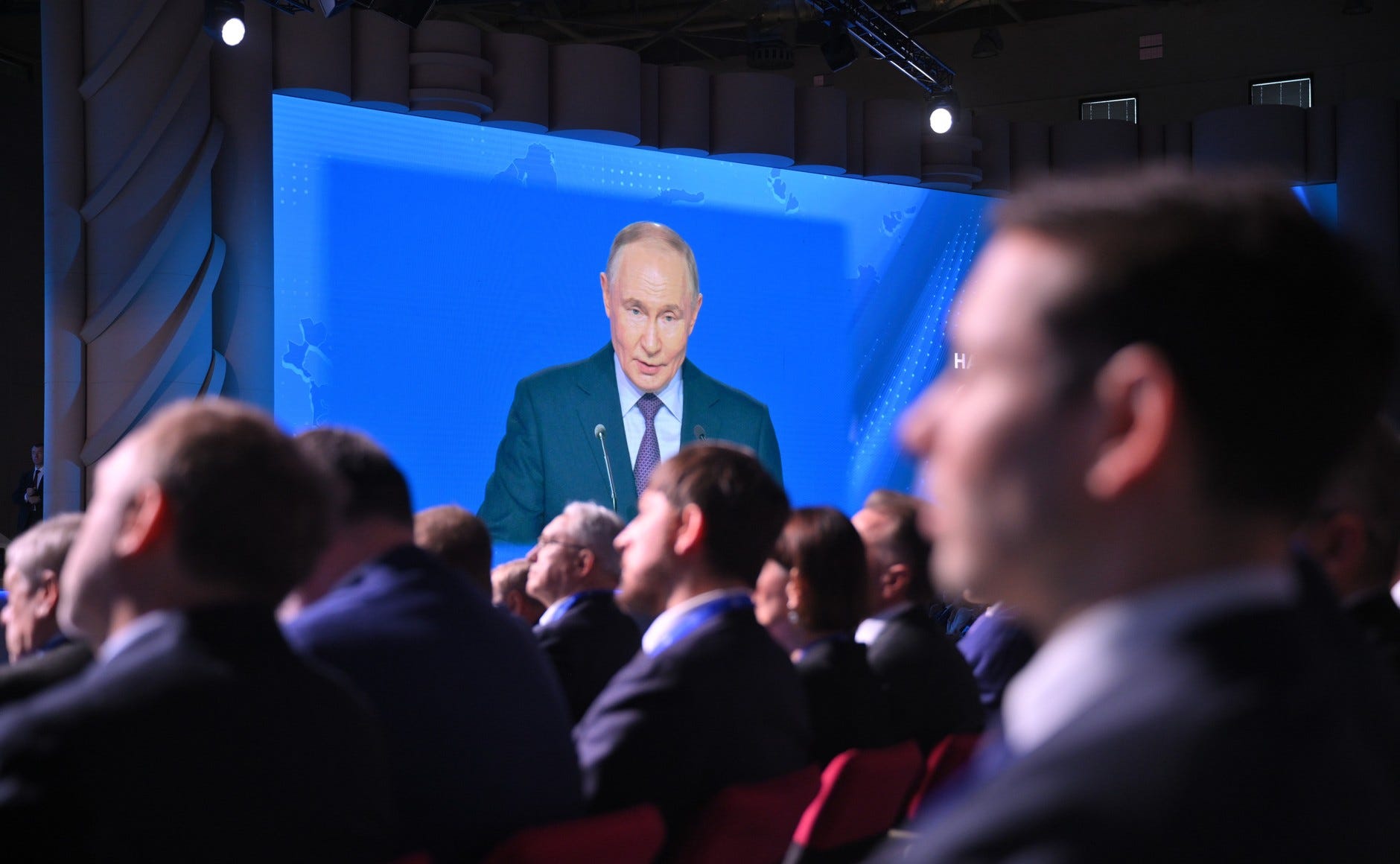
The incident with Shadayev is a good illustration of the extent of the unhappiness within the elite—among both business leaders who are losing money, and officials who have far fewer tools to influence public opinion. The issue has come to the fore in recent months as the FSB seems to be in a hurry to destroy Russia’s remaining elements of free internet, blocking popular messaging app Telegram, cracking down on VPNs, and extending mobile internet blackouts.
The anger in Russia’s business elite, which is losing billions of dollars, is particularly intense. And matters have been made worse by the Kremlin’s refusal to engage in discussions.
“High-quality internet is a matter of national competitiveness. Without it, your country is cut off from global progress,” complained a source close to the leadership of a big Russian IT company.
At a meeting with the country’s wealthiest businessmen last month, the issue of internet blackouts was raised with Putin. The head of the Russian Union of Industrialists and Entrepreneurs (the so-called “oligarchs union”) told Putin that shutdowns had made life harder for businesses, as well as ordinary people, and asked for a solution. Putin sidestepped the question. At a subsequent closed-door meeting, he also failed to offer an explanation, and made no promises, according to two Vlast sources who had knowledge of the gathering.
At the same time, Russian officials are irritated about being obliged to abandon Telegram and move their public communications to MAX, a messaging app developed by a Russian company close to the security services. All state employees will soon be legally required to use MAX for work communications.
However, the two government sources and another ten sources across government agencies and state companies told Vlast that state employees and politicians have been buying new phones and “clean” SIM cards solely to use MAX.
“Everyone believes that installing MAX on your phone is the same as handing it over to the FSB,” said the source close to the government whose children were unhappy.
Others are still holding out hope that a compromise solution will be found. A source from a federal agency said that no one wants to lose Telegram: “Everyone hopes [Telegram founder Pavel] Durov will come up with something to bypass the restrictions, or that the problem will somehow resolve itself.”
Just like business executives leaking to the press, dissatisfaction among officials has also spilled over into the public sphere. The governor of Belgorod region, which borders Ukraine, complained last month that, unlike Telegram, MAX does not have push notifications, which means local residents will not be able to get timely alerts about incoming Ukrainian missiles and drones.
Russian political parties (which express some token opposition but are ultimately loyal to the Kremlin) are well aware of the public anger about the internet restrictions, and have spoken out about the blocking of Telegram—apparently seeking to boost their popularity ahead of parliamentary elections in September. The New People party, which was created by the Kremlin to channel liberal votes, has been the most outspoken. But there has also been criticism from the Communist Party, Just Russia, and the Liberal Democratic Party of Russia (which expelled a State Duma deputy whose active role in the debate made it look as if the party was in favor).
Notably, the popularity of New People reached an all-time high Friday, according to state-owned pollster VTsIOM. A total 12.3 percent of those surveyed by VTsIOM said they would vote for New People in elections, up 1.5 percentage points from a week earlier (a significant jump). Support for the ruling party, United Russia, has been falling in recent months, currently standing at a five-year low of 29.7 percent.
Putin’s influential deputy chief of staff Sergei Kiriyenko, who oversees domestic politics, has made no public statement about the restrictions—but many suspect he is unhappy at being deprived of Telegram (a key tool of communication), and worried that public anger could complicate the State Duma elections at which he is expected to deliver a comprehensive victory for United Russia. Tellingly, Kiriyenko seems to have allowed the expressions of dissent from political parties (as long as there is no direct criticism of Putin or the FSB). It’s also significant that the Central Election Commission has given permission for campaigning to take place on Telegram.
It seems possible that the FSB is seeking to establish total control over the internet before the formal start to campaigning in the State Duma elections in June. The high-ranking source close to the government said that the FSB is particularly powerful during wartime, and, if the fighting in Ukraine ended, the FSB might have to give up its desire for such total control. “They [the FSB] are pushing because there won’t be another opportunity,” he said.
All Vlast’s government sources said it’s impossible for anyone within the system to really oppose the FSB. The spy agency is adept at manipulating the internet-illiterate Putin, who tends to trust their recommendations—particularly in wartime.
Our sources believe there is only one development that could change Putin’s mind: if Russia’s token opposition parties (particularly the Communists) see a significant rise in their popularity. If that happens, one source suggested, Kremlin officials could show Putin the alarming polling numbers, and successfully propose a compromise.
Analysis in brief
Police carried out searches Thursday at the Moscow offices of Novaya Gazeta, one of the few independent media outlets still operating in Russia (the newspaper’s editor-in-chief, Dmitry Muratov, received the 2021 Nobel Peace Prize). The search lasted 12 hours, and investigative journalist Oleg Roldugin was detained. Until last year, Roldugin was editor-in-chief of the Russian weekly journal Sobesednik, which was occasionally critical of the authorities.
Putin gave permission last week for the transfer of two famous icons to the Russian Orthodox Church. The Vladimir icon (a masterpiece of 12th-century Byzantine painting) and the Donskaya icon (from the 14th century), which are both considered miracle-working by the Russian Orthodox Church, were moved from Moscow’s Tretyakov Gallery to the Cathedral of Christ the Savior. This was the second such transfer since the start of the full-scale war in Ukraine (the first was the 15th-century Trinity icon painted by Andrei Rublev in 2023).
Patriarch Kirill said Saturday that he had asked Putin to authorize the transfer, and that people should now pray before these icons “for our Fatherland, for our Orthodox President Vladimir Vladimirovich, for the authorities, for the army, that the Lord may protect our Fatherland and not allow those who wish evil upon our country to achieve their goals.” Art historian Elizaveta Likhacheva told the BBC Russian Service this week that the move is a sign of “magical thinking” within some in Putin’s inner circle, who believe that religious devotion can help Russia prevail in the Ukraine war.
Russia looks to tap $1.3 trillion instant payment network
If the Finance Ministry decides to go ahead and levy taxes on transactions in the popular Faster Payments System (FPS), it could affect millions of ordinary people.