


Hello and welcome to Vlast! In this special edition we look at Patriarch Kirill, head of the Russian Orthodox Church, who recently marked his 80th birthday with much fanfare. What did the festivities tell us? Is Kirill showing signs of aging? What are his relations with Putin? And how has the war in Ukraine damaged the Russian Orthodox Church?
We have lifted the paywall for this newsletter to make it free for everyone! If you would like to access all our newsletters, though, consider taking advantage of our Black Friday offer and upgrading to a paid subscription.
⏳️️️️️️️ This newsletter has 1,597 words and will take about 7 minutes to read.
To mark his 80th birthday on November 20, Patriarch Kirill, the head of the Russian Orthodox Church, met top Kremlin officials and led a service in Moscow’s Christ the Savior Cathedral for well-wishers and Orthodox religious leaders from across the world. President Vladimir Putin gifted him a large icon while other presents included a 19th-century painting and honorary citizenship of Moscow. Across Russia, there were concerts, exhibitions, and operas in his honor—while state-owned television released a four hour documentary about his life. Congratulatory billboards were even put up on Russian streets.
But the pomp and ceremony failed to hide the damage the full-scale invasion of Ukraine has done to the standing of the Russian Orthodox Church in recent years. Indeed, the celebrations highlighted the Church’s international isolation and how its growing dependence on an ever more totalitarian regime has weakened it domestically.
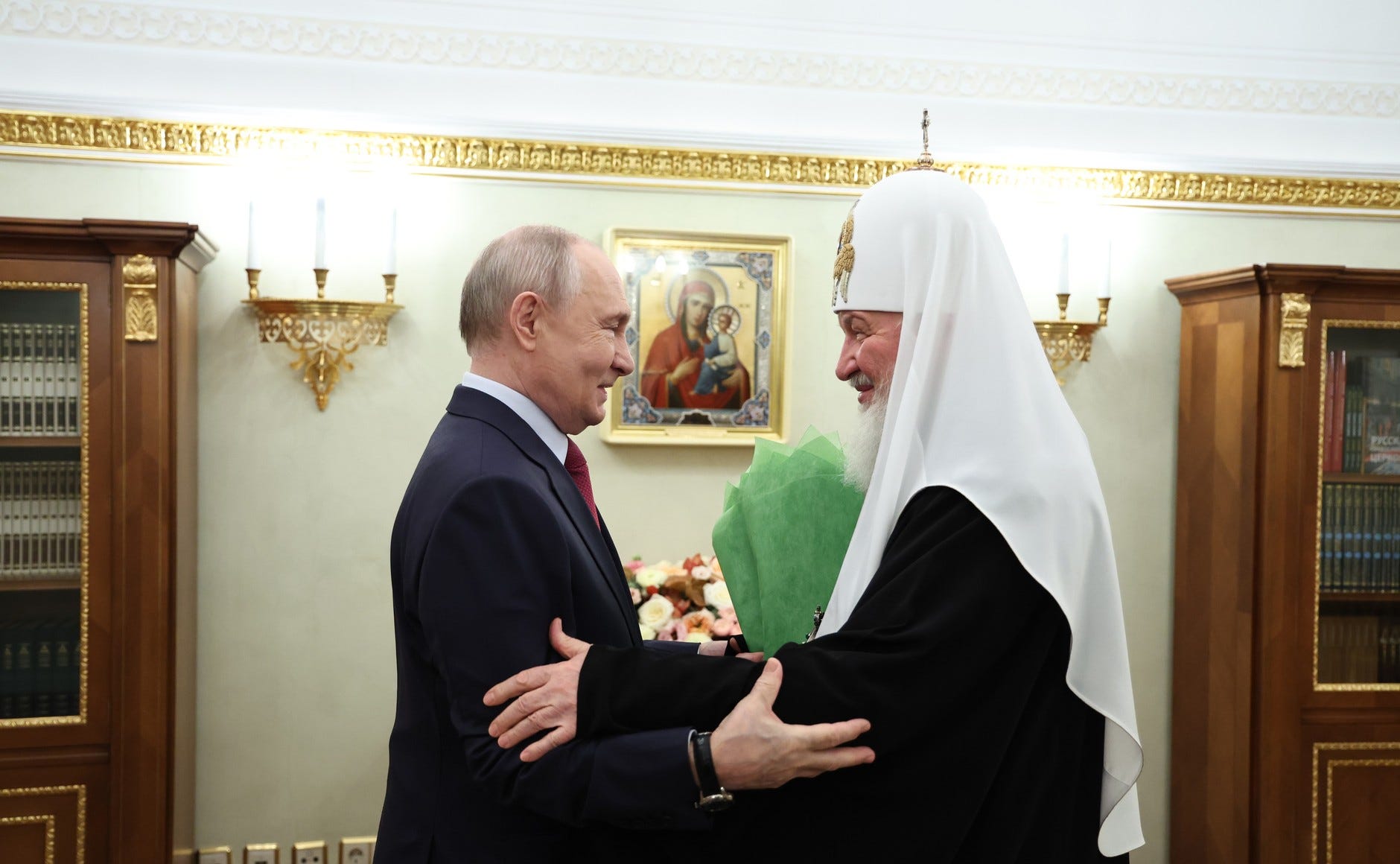
What did we learn about Kirill’s political standing? Kirill is not just the head of the Russian Orthodox Church; he is also—in effect—a very senior official in Russia’s bureaucracy who has regular meetings with Putin and attends high-profile official gatherings. As such, the Moscow Patriarchate issued press releases that said he had been formally congratulated on his birthday in person by Putin, Prime Minister Mikhail Mishustin, and Moscow Mayor Sergei Sobyanin. Good wishes also poured in from other members of Russia’s political and cultural elite.
In an interview for the four hour documentary about Kirill directed by Serbia’s Emir Kusturica, Putin said relations between church and state were “stable,” that he had a “true friendship” with Kirill, and recounted an unconfirmed story that he was secretly baptized as an infant by Kirill’s father. The two men were also shown together earlier this month when they toured an exhibition of modern Christian art dedicated to Kirill’s 80th birthday (exhibits included paintings of the war in Ukraine and Putin opening a bridge to occupied Crimea, as well as a bronze bust of Kirill).
While Kirill is known for his emphatic support for Putin and Russia’s war in Ukraine, experts and regime insiders do not believe the two men actually have particularly close personal ties. “You can’t call Putin and the patriarch friends,” said a source close to the Kremlin who knows both men. “The relationship is pragmatic on both sides.”
Significantly, Putin did not attend Kirill’s birthday service in Christ the Savior Cathedral and independent media reported that the footage of the president giving Kirill a bunch of white roses and an icon on his birthday was recorded several days earlier. In other words, Putin did not actually see Kirill on November 20.
“Kirill has shown that he is 100 percent supportive of Putin and this is all that Putin needs,” said Sergei Chapnin, a director of communications at the Orthodox Christian Studies Center at Fordham University and a former employee of the Moscow Patriarchate.
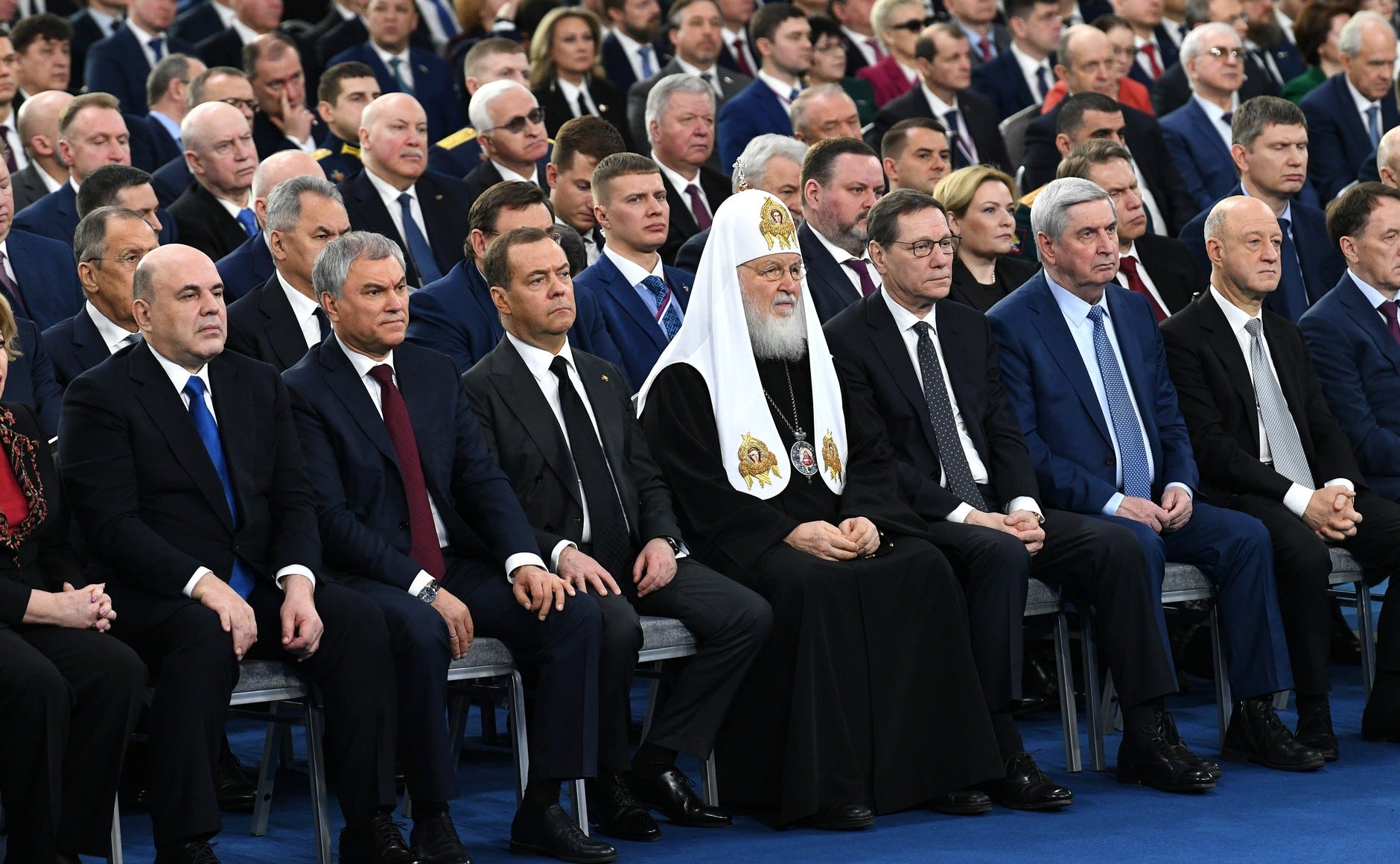
What was the aim of the festivities? Church officials strove to ensure that the celebrations, which lasted several days, successfully portrayed Kirill as Russia’s spiritual leader—and also showed him in lockstep with his secular counterpart Putin.
In another state TV documentary to mark his birthday, Kirill echoed Kremlin talking points, including Russia’s distinct civilizational path, justifications for the war in Ukraine, the decline of the West, and Moscow’s imperial mission. “We represent an alternative path of civilizational development,” said Kirill. “Everywhere [else] people are turning away from Christianity. In the best-case scenario, churches are being turned into mosques. And in the worst-case scenario, they’re becoming terrible entertainment venues.” He also warned that the West was moving “toward the total domination of evil.”
Strikingly, much of what Kirill said in the documentary (including about Ukraine) was not aimed at a religious audience, according to Nadezhda Beliakova, a historian of the Russian Orthodox Church at Germany’s Bielefeld University. “The message was political rather than pastoral.”
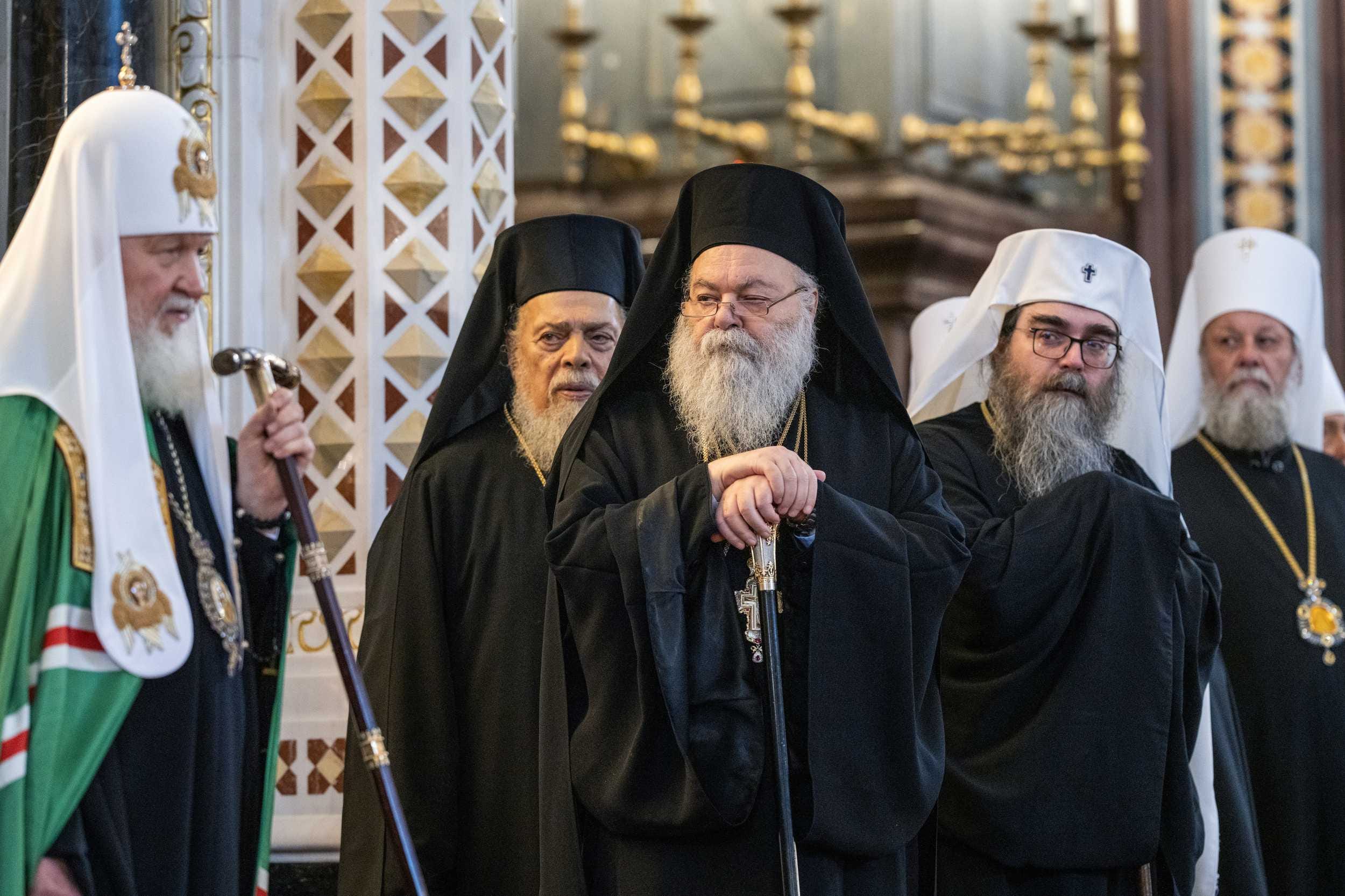
Which religious leaders attended? Four of the world’s 13 other Orthodox primates came to Russia for Kirill’s birthday, including the Patriarch of Jerusalem Theophilos III, the Patriarch of Antioch John X, and the Patriarch of Serbia Porfirije. In a minor diplomatic victory for Moscow, the service in Christ the Savior Cathedral was the first time Theophilos and John had concelebrated amid a long-running dispute between their two churches. This was also Theophilos’ second trip to Moscow in three weeks, an unprecedented occurrence. He previously came to Russia to meet with Putin on November 5.
However, the event was also notable for those who were not present (five more primates attended Kirill’s 70th birthday celebrations in 2016). Russia’s opposition to independence for the Orthodox Church of Ukraine meant that the Patriarch of Constantinople and Patriarch of Alexandria were absent (both churches recognize Ukrainian autocephaly). And there were no patriarchs from European Union countries.
Nor did the Vatican send a representative. Despite a historic meeting between Kirill and Pope Francis in 2016 (the first ever between a pope and a Russian Orthodox patriarch), relations with the Catholic Church have deteriorated. Famously, Francis warned Kirill in 2022 that he should not be “Putin’s altar boy.”
Is Kirill’s age affecting his ability to do his job? Some believe the 80-year-old patriarch is showing signs of frailty and confusion. While the Moscow Patriarchate has never confirmed any specific illness, Ksenia Luchenko, a journalist and expert on the Russian Orthodox Church, said he was increasingly erratic and pointed to an incident in April 2026 when Kirill muddled two religious festivals.
“We don’t know the extent of any illness, a diagnosis, or prognosis, but it’s obvious there is some reduction in cognitive function,” she said. “Before he was chosen as patriarch, Kirill was viewed as an orator, a theologian, and someone who could communicate great ideas. But now we see a mumbling old man in the style of Brezhnev.”
Expert Chapnin was unimpressed by Kirill’s sermon for his birthday service. “I was thinking he would really prepare his sermon. But it was rubbish. It was just made up of oft-repeated, well-known points from his old speeches,” said Chapnin. “This is intellectual decline.”
Kirill’s advanced years, though, are not unusual for Russia, where the average age of top officials has crept upward as Putin grows older (the president is now 74). The average age of permanent members of the Security Council (a key decision-making body) was 53 in 2006, 59 in 2016, and is now 63. Its two oldest members are Federation Council head Valentina Matviyenko, 77, and Foreign Minister Sergei Lavrov, 76.
Nor is Kirill unusual in the Orthodox world. The fourth oldest of the 14 Orthodox primates, the Russian patriarch is younger than the Patriarch of Constantinople Bartholomew I (86), the primate of the Orthodox Church of Greece Ieronymos II (88), and the primate of the Polish Orthodox Church Sawa (88). Nor is he the longest-lived of recent Russian Orthodox patriarchs: Alexei I was 92 when he died in 1970.
Could Kirill be replaced? Orthodox patriarchs do occasionally step down, but this is rare and most tend to leave office only when they die. Few believe that resigning is something Kirill would ever consider and there are no obvious candidates to take over if he were to depart. Over the course of his tenure as patriarch, Kirill has followed a strategy similar to Putin’s by removing all the independent figures within the Russian Orthodox Church who could be seen as possible successors.
“He loves power and he won’t leave,” said Chapnin. “There is no threat to Patriarch Kirill today—no sort of threat. Just age.”
How has the Ukraine war impacted the Church? Most significantly, Kirill’s support for the war in Ukraine has led to the growing international isolation of the Russian Orthodox Church and an ever-greater reliance on Putin. “Despite what he says to the cameras, the patriarch is in a weak position because of his dependency on the regime,” said Beliakova. “His position has weakened further since the start of the war.”
The full-scale invasion of Ukraine has not only damaged the Russian Orthodox Church’s reputation (Kirill was even sanctioned by the United Kingdom in 2022), but also led to a major loss of influence in Ukraine, exacerbated the geopolitical conflict with the Patriarchate of Constantinople, caused the destruction of hundreds of religious buildings in Ukraine, and curtailed the flow of young men into Russian seminaries (many of whom used to come from Ukraine).
Being able to appeal to a broader community of sympathetic Christians was traditionally an important part of the Russian Orthodox Church’s dealing with the state, according to Beliakova, and losing this leverage has been deeply damaging. “These festivities showed Kirill can no longer appeal to a global community and wields no international influence,” she said. “In this sense he is more vulnerable.”


