


When Russian President Vladimir Putin’s flagship economic forum opened in St. Petersburg on Wednesday, plumes of black smoke from Ukrainian drone attacks hung over the city—a dramatic reminder of the military, economic, and political problems facing the Kremlin. Putin’s address to delegates later on Friday is unlikely to shed much light on these issues. Symbolically, the forum has become a substance-lite PR exercise amid the war in Ukraine: just another way for the Kremlin to manufacture news for state-owned media.
In this Vlast newsletter we look at:
Why Kremlin managers believe “re-activating” Putin in recent months will help to boost his image and reverse his sliding poll ratings;
Whether Russia is heading for a fiscal crisis driven by ever-growing defense spending.
We also briefly examine United Russia’s selection of Ukraine war veterans to stand in September parliamentary elections, and gasoline shortages in annexed Crimea.
⏳This newsletter contains 2,234 words and will take about 11 minutes to read. It was translated and edited by Howard Amos.
How is Putin trying to turn around his falling approval ratings?
After a noticeable absence from the public eye in early 2026, there has been an increase in the number of Putin’s public appearances, including trips to China and Kazakhstan.
There has been an uptick in President Vladimir Putin’s public appearances in recent months as Kremlin managers try to burnish his image and stop a steady decline in support. According to Vlast’s calculations, Putin was seen in public 60 times in April and May—more than the previous three months combined.
In March, Vlast was the first outlet to report that Putin had scaled back his public activity, and almost entirely stopped traveling outside of Moscow. In January, February, and March, Putin appeared in public 25 percent fewer times than the same period last year, and 50 percent fewer than in 2024. His absence was particularly noticeable amid an unusually strong wave of public discontent fueled by intensifying online restrictions.
However, as data from Russian polling agencies began to show a steady slide in Putin’s approval ratings earlier this year, a decision was taken that Putin needed to work on his image. This is an old PR trick used by Kremlin political managers, who believe showing Putin surrounded by adoring crowds, foreign leaders, and deferential officials help dispel doubts about his capabilities, and boost his popularity.
For example, in the aftermath of the rebellion by mercenary leader Yevgeny Prigozhin in 2023, Putin was seen meeting people on the streets of the North Caucasus republic of Dagestan. Each of Putin’s public appearances are, of course, covered extensively—and positively—by state-owned media.
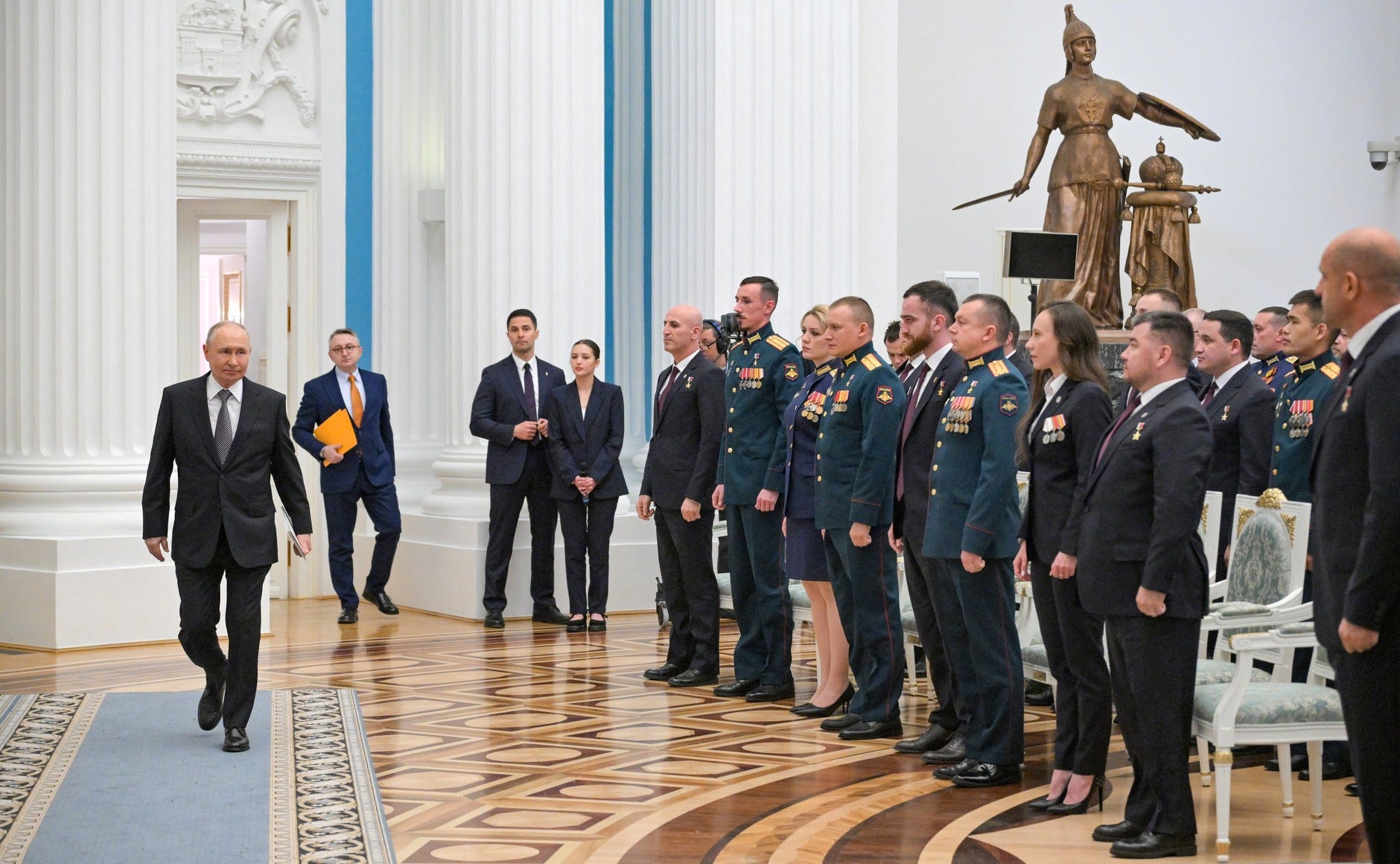
In recent months, Putin’s efforts to be more visible have been hard to miss. Most notably, the Kremlin organized two encounters for Putin that were supposed to showcase his closeness to ordinary people, as well as his human side. One of them was a meeting with his 92-year-old high school German teacher, Vera Gurevich. The Kremlin released a video of Putin picking up Gurevich from a hotel in downtown Moscow and driving her to the Kremlin for dinner. Wearing jeans and carrying flowers, Putin was shown hugging and kissing his former teacher (of course, next to the 92-year-old woman, the 73-year-old president appeared particularly youthful). According to Kremlin spokesman Dmitry Peskov, the encounter brought Putin “the joy of simple human interaction.” The second such meeting was with a young Chinese man who had first encountered Putin as a boy in 2000.
Just as Putin has been more visible inside Russia, so he has also taken more foreign trips. In May, he went to China and Kazakhstan. Although both visits were light on substance, they generated lots of photo ops, and news coverage on state-owned media.
While the necessity of a trip to China is difficult to dispute (Moscow is heavily dependent on Beijing’s support amid the war in Ukraine), it was clearly not essential for Putin to go to Kazakhstan. Indeed, this trip may have been specifically requested by the Kremlin to convince Russians that Putin remains in demand on the international stage. Notably, the trip to Kazakhstan was a state visit (the second in less than a year) with all the attendant pomp and ceremony.
Nevertheless, despite Putin’s recent “activization,” the number of times that he has been seen in public in 2026 remains lower than previous years. Between January and June, Putin took part in 22 percent fewer public events than the same period last year, and up to 34 percent fewer than in both 2024 and the pre-pandemic year of 2019.
Putin also continues to shun Russia’s regions. In the first five months of this year, he left Moscow only twice—both times to go to St. Petersburg. In comparison, in the same period last year he made eight regional trips, in 2024 he made 14, and in 2019 he went on 17. The last time Putin publicly visited a Russian region (not counting St. Petersburg) was when he went to the Volga River region of Samara in November.
We arrived at the numbers for Putin’s public appearances by counting press releases and transcripts published by the Kremlin. We did not include pre-recorded bilateral meetings—so-called “canned” events—which are released weeks, or months, after they take place (helping create the impression Putin is always busy). Even if “canned” events are included, Putin attended 14 percent fewer events this year, and 23 percent fewer than 2024.
Have the Kremlin’s efforts helped Putin’s ratings?